Turn facility knowledge into staff training your team can use and leaders can trace.
The Nurse Consultant builds facility-specific training manuals, orientation programs, competencies, and evidence records for nursing homes - shaped around your approved policies, resident needs, risk priorities, and staff roles.
Built for Administrators, Directors of Nursing, Staff Development Coordinators, QAPI leaders, HR, department heads, and nursing-home owners.
Training breaks down when the evidence trail breaks down.
A facility may have policies, slides, and sign-in sheets yet still struggle to show that the right person received the right instruction, could perform the expected task, and was updated when risk or policy changed.
Common gaps we help organize
- Orientation starts, but role-specific supervision, restrictions, and follow-up are not clear.
- Annual education misses night, weekend, PRN, agency, contractor, or indirect-care staff.
- Records show attendance but not competency, remediation, version control, or QAPI follow-up.
- Policy changes do not reliably reach the staff, forms, lessons, and evidence records they affect.
A living facility training system - not another generic content library.
We organize written, online, video, testing, competency, and tracking materials around your facility assessment, approved policies, staff roles, and leadership review process.
Facility-specific manuals
Training standards, matrices, calendars, staff instructions, and control tools that reflect the facility's actual operational context.
Orientation programs
Day-one, department, probationary, annual, and remedial learning paths with clear role and supervision boundaries.
Competency and evidence
Checklists, scenarios, return demonstrations, rosters, remediation records, and version-control practices.
CNA and direct-care support
In-service, onboarding, and competency-support materials. State-approved CNA program and certification status must be verified separately.
QAPI-linked updates
A practical route from audit finding, incident trend, grievance, or policy change to targeted education and recheck.
Resident and family education
Plain-language materials and communication tools aligned to facility policy and leadership approval.
From facility intake to staff-ready training.
Assess
Collect the facility assessment, resident needs, policies, survey and audit history, incident trends, QAPI priorities, equipment, staffing patterns, and current records.
Build and curate
Create or update manuals, lessons, scenarios, quizzes, competencies, rosters, remediation tools, and evidence-binder controls.
Review and approve
Route the material through the facility's Administrator, DON, staff-development, QAPI, privacy, medical, and legal reviewers as appropriate.
Deploy, track, and update
Assign by role and risk, record completion and competency, manage overdue items, and connect later changes back to the current content.
Download the sample facility-training manual.
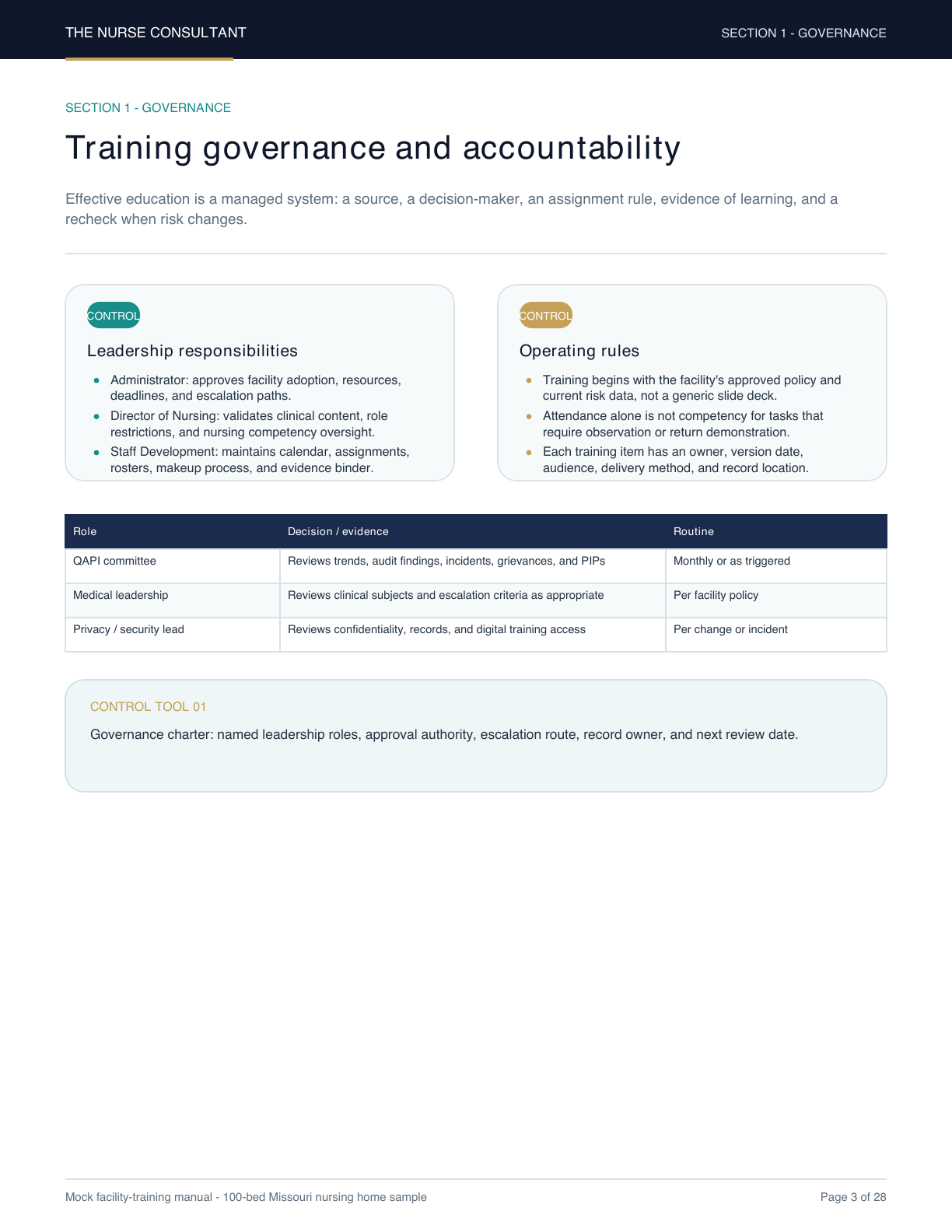
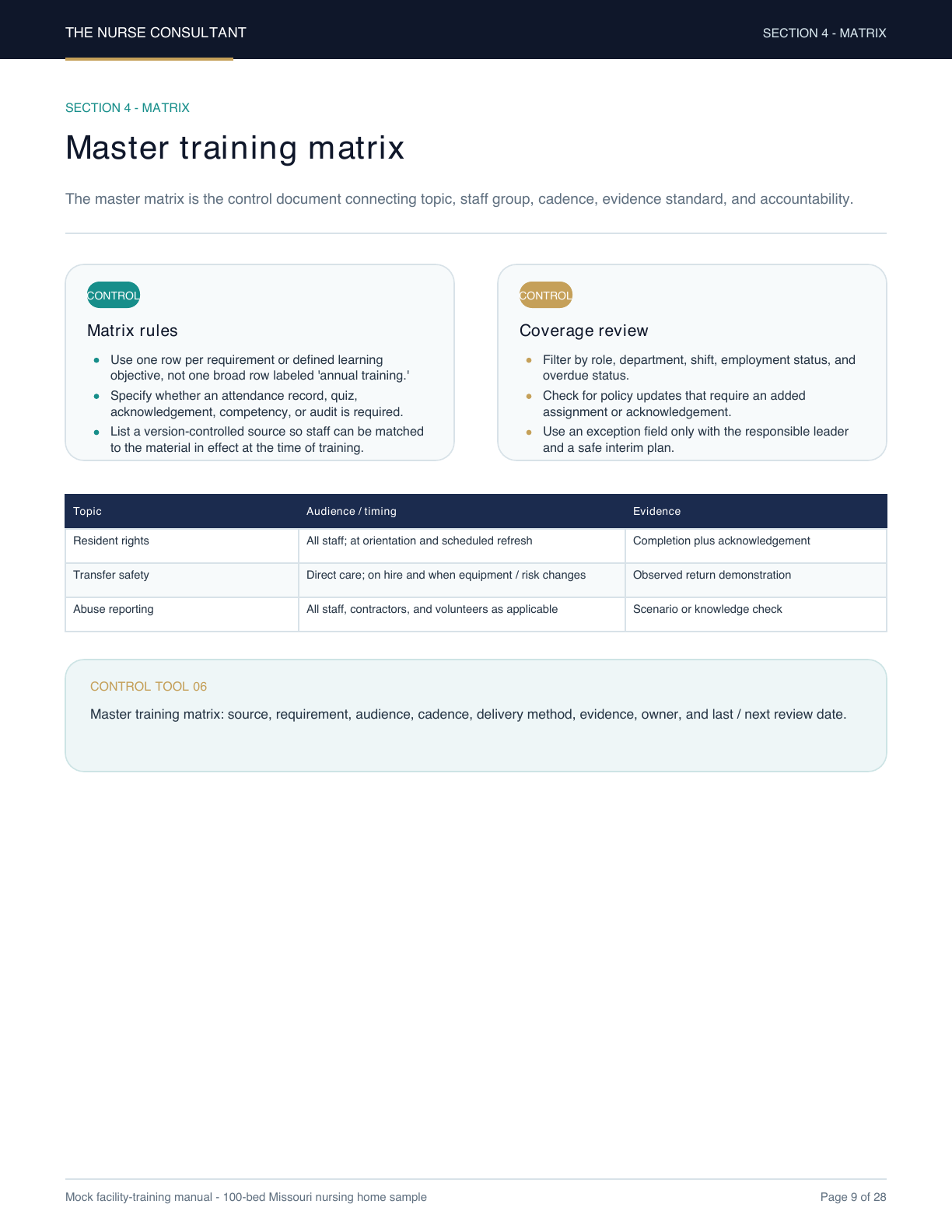
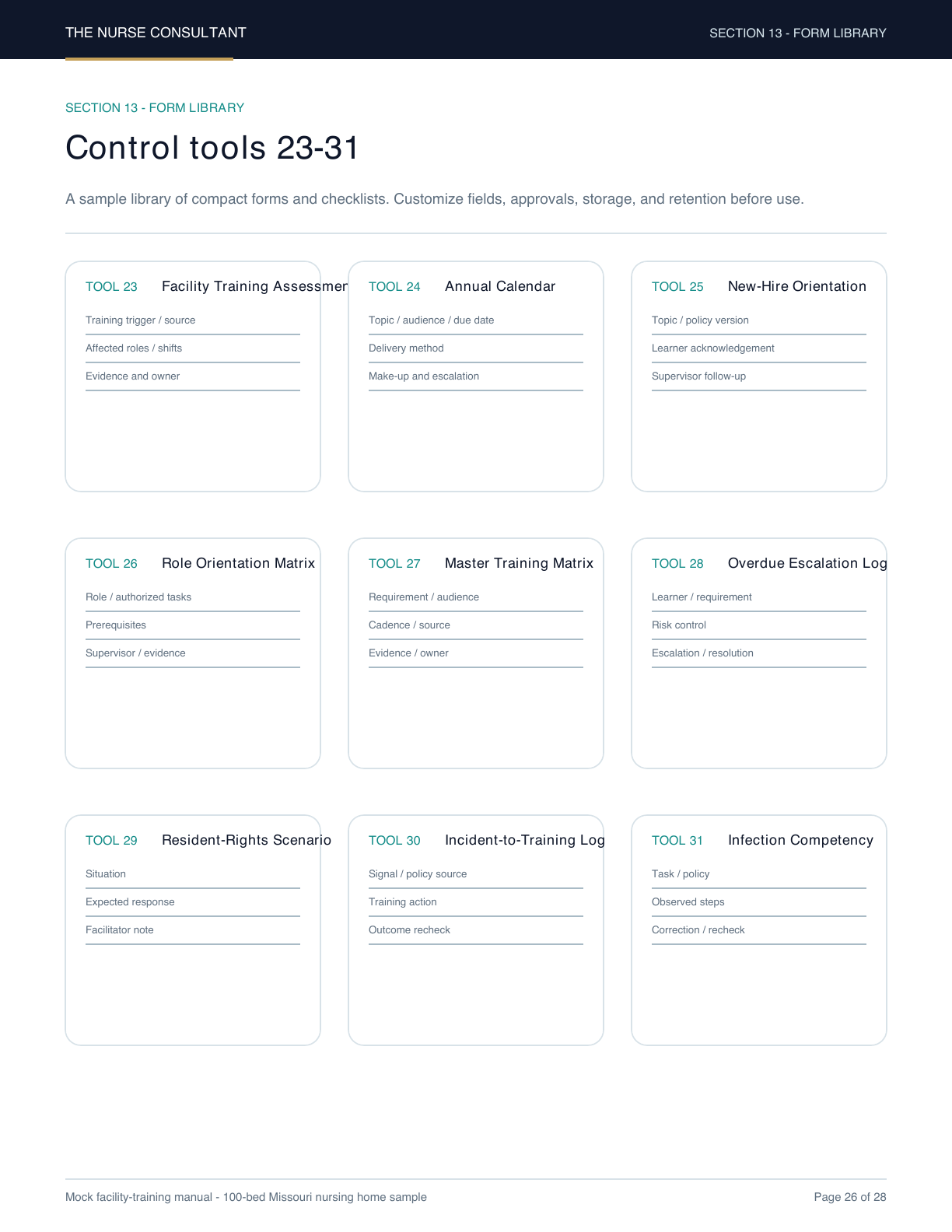
This mock 100-bed Missouri nursing-home manual shows the structure, documentation style, safeguards, and leadership controls available for a facility-specific build.
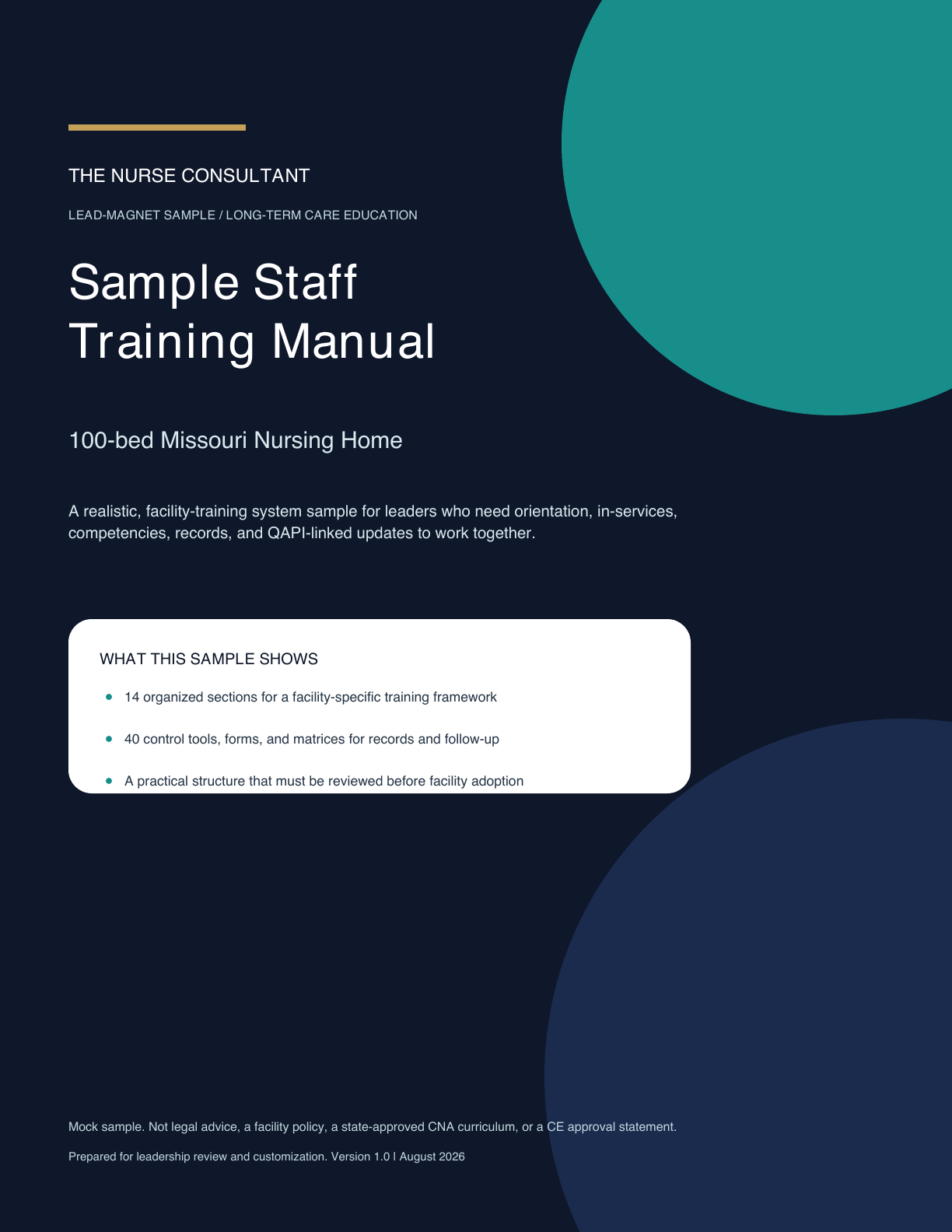
A useful first conversation begins with the structure.
- See how a facility assessment can inform the audience, source, timing, and evidence for education.
- Review what makes an orientation and competency record easier to reconcile.
- Use the sample to identify what you want a tailored facility training review to cover.
The sample is for evaluation only. It is not a facility policy, legal advice, a state-approved CNA curriculum, or a CE approval statement.
What a facility can ask us to create.
| Facility need | TNC deliverable | Evidence to organize |
|---|---|---|
| New employee onboarding | Day-one and department orientation, supervised-assignment rules, role checklists, and 30-day follow-up. | Checklist, acknowledgement, quiz, supervisor checkoff, competency, remediation log. |
| Annual education | Calendar, monthly in-service plan, make-up route, role assignments, lessons, scenarios, and tests. | Roster or LMS completion, score, source version, acknowledgement, overdue report. |
| Direct-care competency | Skills support, scenario labs, return demonstrations, and recheck tools. | Observed competency, corrective coaching, revalidation record, audit follow-up. |
| Policy or QAPI update | Focused education, change log, leadership review, staff assignment, and outcome recheck. | Approval date, content version, completed acknowledgement, QAPI action / audit. |
| Resident or family communication | Resident-rights refreshers, visitor education, family sheets, FAQs, and communication scripts. | Approved materials, sign-in or acknowledgement, feedback / audit route. |
Practical answers before you invest in a build.
Do these materials replace our facility policies?
No. The strongest use of this service starts with the facility's approved policies and turns them into staff-ready learning, evidence, and update controls. Facility leadership remains responsible for review, approval, and adoption.
Can this be built for Missouri nursing homes?
Yes. The sample is written for a fictional 100-bed Missouri nursing home and can be adapted to a facility's actual licensure category, federal certification status, resident needs, staffing model, current guidance, and policies.
Can you support CNA training?
We can create CNA in-service, onboarding, competency-support, and facility-specific direct-care materials. State-approved CNA program and certification status must be verified separately through the facility and current Missouri requirements.
Do these materials award continuing-education credit?
No. TNC provides non-credit training and completion records. These materials do not award CEUs, continuing-education hours, or licensing credit.
How is this different from an LMS course library?
A course library teaches general concepts. This service connects content to your facility assessment, approved policies, roles, risk priorities, QAPI data, records, and leadership review process.
Start with the sample manual.
Review the structure, identify your facility's likely gaps, and decide what a tailored training system should include.